
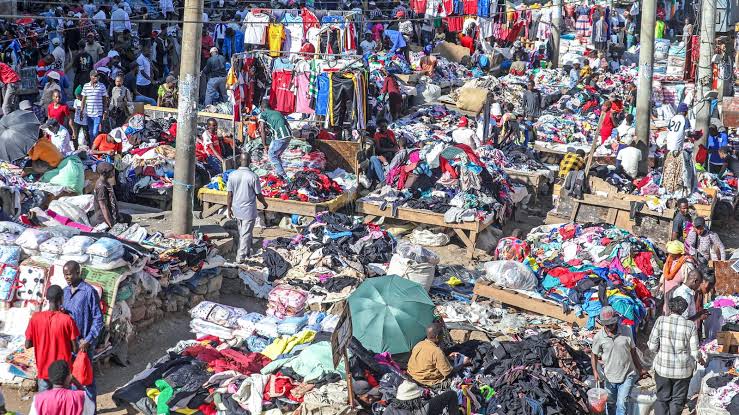
The Finance Bill 2026, published on 5th May by the National Treasury, includes a proposal that has sparked immediate backlash from traders and consumers across the country. Tucked inside the Bill is a new Section 12H of the Income Tax Act, which would create a tax specifically targeting the importation of worn clothing, worn footwear, and other second-hand goods classified under tariff heading 6309. In plain language, this is a mitumba tax.
If you sell, buy, or wear mitumba, here is what the Bill actually says and what it would mean for prices.
What the Bill proposes
The proposed Section 12H states that a tax shall be payable by any person who derives income from importing worn clothing, worn footwear, and other worn articles into Kenya. The Bill then specifies how that income is calculated: the taxable profit shall be deemed to be five per cent of the customs value of the imported goods.
The word "deemed" is doing the heavy lifting here. KRA is not asking how much profit you actually made. It does not care whether you sold a bale at a loss or at a markup. It assumes your profit is five per cent of the customs value, and it taxes that assumed profit.
What that looks like in shillings
Take a trader importing a container of mitumba bales valued at KES 1,000,000 at customs.
Under the proposed framework, KRA would assume that the trader's profit from reselling those goods is five per cent of that value, which is KES 50,000. The applicable income tax rate of 30 per cent is then applied to that assumed profit, giving a tax of KES 15,000.
That KES 15,000 must be paid at the port of entry, before the goods are released. It is a final tax. No further income tax assessment is required on those goods. No filing of returns, no engaging an accountant, no annual profit calculations.
On top of this, the standard 16 per cent VAT still applies at the point of entry, as it does today.
Why the government says this is necessary
The mitumba trade in Kenya is enormous. Millions of Kenyans depend on second-hand clothing as their primary source of affordable apparel. Thousands of traders make their living importing, sorting, and reselling these goods in markets like Gikomba, Toi, and Kongowea.
But the trade operates largely within the informal sector. Most mitumba traders do not file income tax returns. They do not keep books. They do not engage accountants. Income from the trade is almost entirely undeclared.
The Treasury argues that the current system, which in theory requires traders to track their income, calculate their profits, and file annual returns, is unrealistic for this sector. The deemed profit approach is presented as a simplification: pay a small, predictable amount at the border, and you are done.
Why traders and consumers are worried
The concern is straightforward. Any tax added at the point of importation will be passed on to the final buyer. If a trader pays an extra KES 15,000 on a container of bales, the price of each individual item, whether it is a shirt, a pair of shoes, or a jacket, goes up.
For low-income households who rely on mitumba because they cannot afford new clothing, any price increase, however small, is felt. For traders operating on razor-thin margins, an upfront tax payment before goods are even sold adds cash flow pressure.
Critics have also raised a more fundamental objection. Taxing people on income they have not yet earned, and may never earn if goods do not sell, is a departure from how income tax normally works. Income tax is supposed to be charged on actual profit. This proposal taxes fictional profit.
Former Law Society of Kenya President Faith Odhiambo was among those who publicly questioned the measure, highlighting both the affordability impact on consumers and the compliance burden on traders who may not understand the new framework.
What happens next
The Bill has been published and is now before the National Assembly. Public participation is open until 25th May 2026, in line with Article 118(1)(b) of the Constitution. Written submissions can be sent to the Departmental Committee on Finance and National Planning through official parliamentary channels.
Whether this provision survives the public participation process remains to be seen. The memory of the Finance Bill 2024, which was withdrawn after Gen Z-led protests that left dozens dead and forced President Ruto to dissolve his Cabinet, is still fresh. The political appetite for tax measures that directly hit the cost of living for ordinary Kenyans is lower than it has been in years.
We will continue tracking this proposal as it moves through Parliament.
This article is based on the Finance Bill 2026 as published in the Kenya Gazette Supplement No. 113 (National Assembly Bills No. 26), dated 5th May 2026.
Comments (0)
Sign in to leave a comment.