
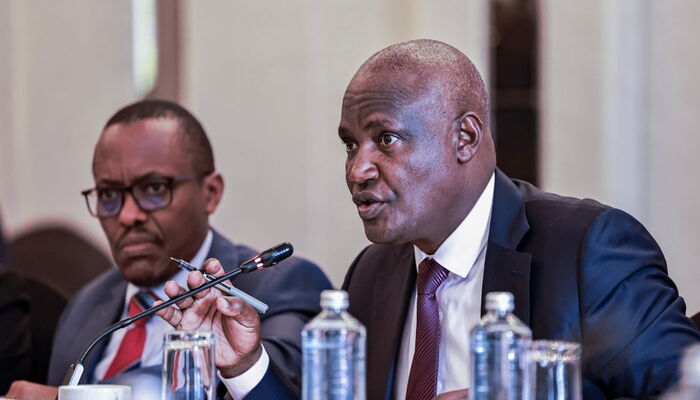
On 3rd February 2026, Treasury Cabinet Secretary John Mbadi stood before cameras and made a promise that landed in the bank accounts of 1.5 million Kenyans. Not literally. But the expectation it created was real.
"Any Kenyan earning KES 30,000 and below should not pay Pay As You Earn. You pay zero," Mbadi said. "I am not even waiting for the Finance Bill to come in June. I am taking a Tax Laws (Amendment) Bill to Parliament."
He said the decision had been made following direct consultations with President William Ruto. He said it was urgent. He said he was not waiting.
The following day, 4th February, President Ruto confirmed it himself while meeting UDA aspirants at State House. "When Parliament resumes next week, we will present a proposal that every Kenyan earning less than KES 30,000 will not pay any taxes because we have steadied the economy," Ruto said.
He went further. Workers earning up to KES 50,000, he said, would see their PAYE rate drop from 30 per cent to 25 per cent. He described the changes as a direct response to the cost of living crisis that had been squeezing Kenyan households.
Four days later, on 8th February, Ruto repeated the commitment at a church service in Embakasi. "All those earning KES 30,000 and below will not pay taxes on their income. This is because our economy is now stable," he told the congregation.
The Kenya Bankers Association backed the plan. KBA submitted a ten-point proposal to the Treasury recommending that income below KES 30,000 be fully exempt, with graduated rates above that: 15 per cent up to KES 50,000, 20 per cent up to KES 100,000, 25 per cent up to KES 400,000, and 30 per cent above that. "The purchasing power of salaried Kenyans has fallen significantly in recent years," KBA CEO Raimond Molenje said. "Adjusting PAYE bands is a practical step to restore household income, stimulate spending, and support businesses."
By late February, the promise was settled public expectation. Workers across the country were waiting for the Finance Bill to arrive with their relief inside it.
Then the Finance Bill 2026 was published.
On 5th May 2026, the National Treasury published the Finance Bill 2026 in the Kenya Gazette. It contains 124 pages of proposed tax changes. It introduces new taxes on mitumba imports, mobile phones, card transaction fees, gambling winnings, and crypto assets. It gives KRA new powers to pre-populate tax returns and treat undistributed company profits as dividends.
What it does not contain is any change to the PAYE bands.
Zero. The first KES 24,000 is still tax-free. The 25 per cent rate still kicks in at KES 24,001. The 30 per cent rate still applies from KES 32,334. Nothing has moved. The 1.5 million workers earning under KES 30,000 who were told they would pay zero are still paying exactly what they were paying before the promise was made.
The Tax Laws (Amendment) Bill that Mbadi said he was "not even waiting" for? It was never tabled.
The Treasury's explanation
When the omission became public, former Law Society of Kenya President Faith Odhiambo was among the first to call it out. She questioned several provisions in the Bill but singled out the missing PAYE relief as particularly significant, given the explicit public commitments from both the President and the CS.
On 11th May, Mbadi responded. He said the proposal had not been abandoned. He said the Treasury was still running simulations on the fiscal impact. According to Mbadi, early projections show the PAYE adjustment would cost the government approximately KES 35 billion per year in lost revenue. The Treasury, he said, is assessing whether increased collection from other sources and spending cuts can offset that gap.
"The proposal is still under active consideration and may be finalised before June 30, ahead of the passage of the bill by the National Assembly," Mbadi said.
In other words, the promise made in February with the language of certainty and urgency has been downgraded to a proposal under consideration that may or may not appear as a parliamentary amendment before the end of June.
What KES 35 billion actually means in context
The Treasury says it cannot afford to lose KES 35 billion in PAYE revenue. That number deserves some context.
The Finance Bill 2026 introduces several new revenue streams. It proposes taxing mitumba imports, widening the excise duty on mobile phones, taxing gambling winnings, introducing withholding tax on card interchange fees, removing VAT exemptions on fintech services, and expanding the capital gains tax net. It also gives KRA new tools to enforce compliance, including pre-populated returns and mandatory digital registration for landlords.
If these measures work as intended, they will generate new revenue. The question is whether any of that new revenue has been earmarked to fund the PAYE relief, or whether the two objectives are being treated as separate and unrelated.
When Ruto made the promise in February, he did not say "we will reduce PAYE if we find enough money from other sources." He said "every Kenyan earning less than KES 30,000 will not pay any taxes because we have steadied the economy." The framing was that the economy had improved enough to afford it. Three months later, the economy apparently has not improved enough.
What workers are actually paying
The cumulative deduction burden on salaried Kenyans has grown significantly in recent years, and the PAYE bands have not kept pace.
A worker earning KES 30,000 per month currently faces PAYE of approximately KES 1,100 after personal relief of KES 2,400. On top of that, they pay NSSF contributions (KES 1,740 under the 2013 Act rates), SHIF at 2.75 per cent of gross salary (KES 825), and the Affordable Housing Levy at 1.5 per cent (KES 450). That is over KES 4,100 in statutory deductions before rent, food, transport, or school fees.
For someone earning KES 30,000, losing KES 4,100 to mandatory deductions is not a rounding error. It is the difference between making it through the month and not.
Removing the PAYE component for this group, roughly KES 1,100, would not transform their lives. But it was promised. And promises from a sitting President, made on multiple occasions, in front of cameras, carry weight.
The political dimension
This is not the first time a Finance Bill has arrived without delivering what was expected. But the gap between promise and delivery is unusually visible this time because the promises were unusually specific.
Mbadi did not say "we are exploring options." He said "you pay zero." Ruto did not say "we hope to present a proposal." He said "we will present a proposal when Parliament resumes next week."
Parliament resumed. No proposal was tabled. The Finance Bill arrived three months later without the changes. And now the explanation is that it costs too much and needs more study.
For a government that remembers what happened in June 2024, when a Finance Bill perceived as anti-ordinary Kenyan triggered nationwide protests and left at least 65 people dead, this omission carries risk. The protesters who stormed Parliament last year were not angry about corporate tax rates or capital gains provisions. They were angry because they felt the government was taking from those who could least afford it.
Leaving PAYE untouched while introducing new taxes on mitumba, phones, and digital payments sends a message. Whether the government intended that message is a political question. Whether voters receive it is not in doubt.
What happens next
Public participation on the Finance Bill 2026 is open until 25th May 2026. Written submissions can be sent to the Departmental Committee on Finance and National Planning at Parliament Buildings, Nairobi, or electronically through official parliamentary email addresses.
Mbadi has said the PAYE adjustment "may be finalised before June 30." That leaves room for the government to introduce it as an amendment during the committee stage or plenary debate. It also leaves room for it to quietly disappear from the agenda altogether.
If the PAYE relief matters to you, the public participation window is the time to say so. Once the Bill passes, the conversation is over until the next Finance Bill.
This article reflects the public positions taken by the President and the Treasury CS as reported in the media between February and May 2026, and the Finance Bill 2026 as published in the Kenya Gazette Supplement No. 113 on 5th May 2026.
Comments (0)
Sign in to leave a comment.